
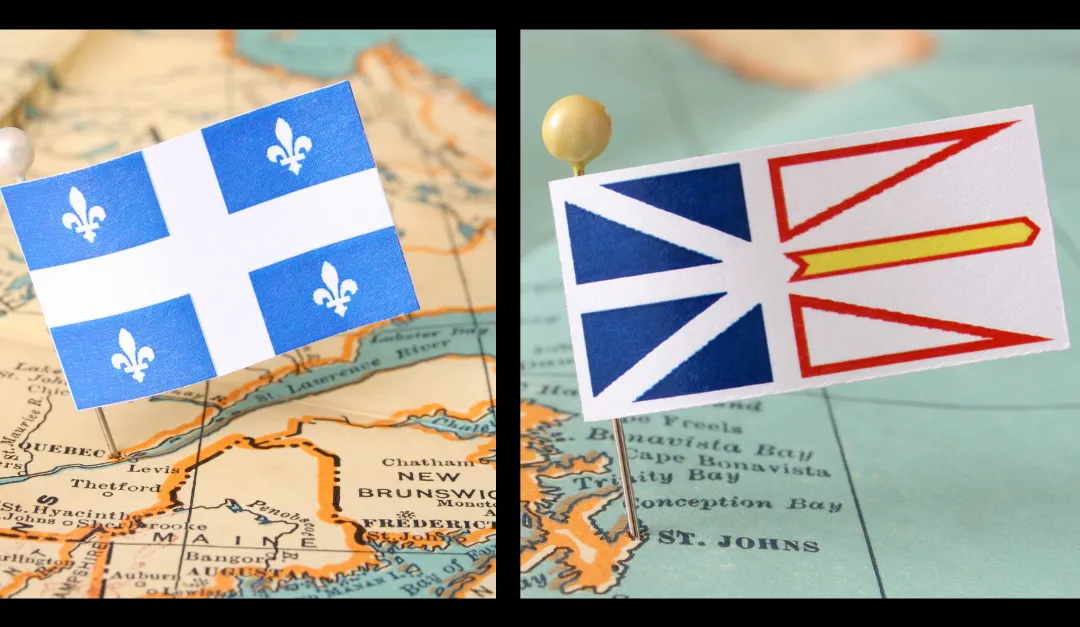
Case: Smiley v. The Pierre Elliott Trudeau Foundation, 2026 NLCA 3 (CanLII)
Keywords: forum non conveniens; Club Resorts Ltd. v. Van Breda, 2012 SCC 17
Synopsis:
The Appellant is a scholar and recipient of Pierre Elliot Trudeau Foundation funding supporting her doctoral studies. The Respondent is her Foundation mentor. The parties attend a conference in St. John’s, Newfoundland organized by the Foundation. (See para. 6). The Appellant alleges sexual battery by the Respondent – touching incidents involving the Respondent cause her to “feel fear because her Foundation funding renewal was conditional on a reference letter from [the Respondent]”. (See paras. 8-9). The Appellant also sues the Foundation (e.g., for vicarious liability and breach of fiduciary duty in the “creation of the situation that led to the alleged battery”). (See para. 3).
Neither party has ever lived in Newfoundland; the Foundation is a federally registered charity based in Montreal. (See paras. 4-5). Although the Supreme Court of Newfoundland and Labrador has jurisdiction to try the Appellant’s action, the Foundation says Québec is the more appropriate forum; applies for an order setting aside or staying the action for forum non conveniens. The Appellant and individual Respondent prefer Newfoundland. (See paras. 2, 12).
The Supreme Court of Newfoundland and Labrador (per Browne J.) stays the action. (See para. 2). The Court of Appeal (Boone, O’Brien, and Noel JJ.A.) affirms that decision. (See para. 7).
Importance:
As succinctly put by the Court of Appeal, “[t]he doctrine of forum non conveniens recognizes that even when a court has the jurisdiction to resolve a dispute, it retains a residual power to decline to exercise that jurisdiction in favour of a forum that is clearly more appropriate for the fair and efficient disposition of the litigation.” (See para. 1).
The reasons of Boone J.A. clarify the application of the doctrine in the digital age. As set out in the decision herein, there are two key issues:
- jurisdiction simpliciter (i.e., whether the jurisdiction of the Supreme Court of Newfoundland is established with respect to the claim); and
- forum non conveniens, which is based on the factors of efficiency, fairness, and comity set out in Club Resorts Ltd. v. Van Breda, 2012 SCC 17, at paras. 108-111 and Unifor Local 2002 v. Exploits Valley Air Services Ltd., 2023 NLCA 3, at para. 30. (See paras. 14-16).
While the Court of Appeal found the Trial Judge “followed the correct approach” to the determination of the motion, Boone J.A. observed that “[o]nly the court of the alternative forum can ultimately decide its jurisdiction after applying its own rules and principles”. (See para. 49). The Trial Judge bifurcated his analysis, determining that courts in Québec have jurisdiction simpliciter over some of the Appellant’s claims. (See para. 15).
Boone J.A. also cautioned against the “piecemeal approach” taken by the Trial Judge with respect to the Appellant’s Statement of Claim (i.e., by indicating that, whereas the courts of Newfoundland have jurisdiction over the tort of sexual battery, the courts of Québec have jurisdiction over the remaining claims). For the Court of Appeal, “[t]he difficulty with such an approach is that it leads to the impression that the issue of jurisdiction simpliciter could be parsed such that the chosen forum could be suggested to have jurisdiction over only part of the claim. The Supreme Court of Canada, in Van Breda, firmly rejected this approach”. (See paras. 50-51).
On appeal, the Appellant argued that the Trial Judge failed to consider and weigh material evidence and that some of the factors considered (i.e., location of witnesses and evidence and the possibility of videoconferencing) “should no longer be considered as relevant to the exercise of discretion”. (See paras. 28-29).
For the Appellant, “as a matter of law, the real possibility of having witnesses testify by video, especially given advances in technology and the experience of court proceedings during the COVID-19 pandemic, has rendered the factor of the location of witnesses as neutral.” (See para. 58, Kore Meals LLC v. Freshii Development LLC, 2021 ONSC 2896 at para. 31). Another authority, Brink’s Global Services Korea Ltd. v. Binex Line Corp., 2022 FC 571, indicates at para. 81 that “some of the traditional factors of forum non conveniens will go the unfortunate way of the dodo bird”. (See para. 59).
However, for the Court of Appeal, location of witnesses remains a factor because,
- the Supreme Court of Canada says so in Van Breda at para. 110;
- forum non conveniens requires a “contextual and fact specific application”; and
- videoconferencing remains “the exception to the usual practice that witnesses testify in person”, remains a “question for the trial judge”, neither party has “the right to insist on testifying by video”, and the question is ultimately made by “weighing advantages against possible prejudice”. (See paras. 61-66; see, also, Black & McDonald Limited v. Eiffage Innovative Canada Inc., 2023 ONCA 91 at para. 22).
Similarly, the Court of Appeal found that the location of documentary evidence was not a factor that “should usually be given significant weight” in the analysis. But that does not mean it is not considered at all. In this case, the Court determined that the Trial Judge did not place undue emphasis on this factor. (See para. 70).
Aside from this discussion of the doctrine of forum non conveniens, the decision helpfully summarizes the standard of review applicable to the discretionary decision to refuse jurisdiction, and the standard of review applicable to grounds of appeal regarding a misapprehension of material evidence. (See paras. 30-33). The former is described in Lapointe Rosenstein Marchand Melançon LLP v. Cassels Brock & Blackwell LLP, 2016 SCC 30 at para. 54:
A motions judge’s discretionary decision to refuse to decline jurisdiction on the basis of forum non conveniens is entitled to considerable deference on appeal: Van Breda, at para. 112. As this Court stated in Éditions Écosociété Inc. v. Banro Corp., 2012 SCC 18 (CanLII), [2012] 1 S.C.R. 636, “an appeal court should intervene only if the motion[s] judge erred in principle, misapprehended or failed to take account of material evidence, or reached an unreasonable decision”: para. 41. Errors of law, as well as “clear and serious error[s]” of fact may also give grounds for intervention: Van Breda, at para. 112. (See para. 30).
The latter is described in R. v. MacIsaac, 2013 NLCA 26 at para. 16, though the following further, “functional definition” is set out in R. v. Deviller, 2005 NSCA 71 at para. 10: “[a] trial judge misapprehends the evidence by failing to give it proper effect if the judge draws an ‘unsupportable inference’ from the evidence or characterizes a witness’s evidence as internally inconsistent when that characterization cannot reasonably be supported on the evidence”. (See para. 33).
Counsel for the Appellant: Kathryn Marshall and Chase Frazer (Marshall Law, Toronto)
Counsel for the Respondent: Colm St. Roch Seviour, K.C. and Koren Thomson (Stewart McKelvey, St. John’s)
Counsel for the Respondent, Stephan Kakfwi: Antoun Alsaoub (Grondin Savarese, Montréal)